Showing posts with label Feedbacks. Show all posts

Saturday, March 8, 2014

Tipping Points

Tipping points sorted by their likelihood of occurring within the next few decades.


Very Likely:
Increased production and emission of carbon dioxide will continue to be a major cause in the increase of the Earth’s temperature and climate changes. If we don’t start cutting emissions now, the effects could become more devastating.
Somewhat Likely:
Having ice-free Arctic summers could start a waterfall effect as higher temperatures could melt permafrost, releasing carbon dioxide and causing further warming and melting.
Not Very Likely:
The runaway greenhouse effect.
One version of the feedback is described as water vapor accumulating in the atmosphere as it warms. The warmer the atmosphere, the more water vapor. The more water vapor that accumulates, the more heat gets trapped, and the temperature continues to rise. This feedback would continue uncontrollably until the oceans have evaporated.
Another version would be that as snow and ice accumulate over the Earth, more and more sunlight is being reflected back into space. This causes a cooling, resulting in more snow and ice, until the entire Earth is covered and becomes frozen.

To read more check out these articles:

Tuesday, March 4, 2014

Ice Albedo Feedback

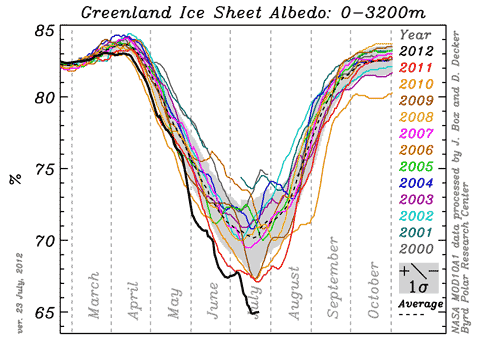
The ice-albedo-feedback is quite simple, but very serious. Snow and ice reflect the sun which means that they do not absorb much of the solar radiation, they have a high albedo. The water around the snow and ice is much darker, absorbing more of the Sun's radiation (a low albedo), causing the water to heat up. This heating then melts the snow and ice, exposing more of the water, absorbing more of the sun and heating more, and so on. The more water is exposed, the more heat it absorbs. The more heat it absorbs, the more the ice melts exposing more water.


Figure 1: Ice Sheet Albedo
Image Source: http://hot-topic.co.nz/wp-content/uploads/2012/07/GISalbedo201207.png

You can see in this figure how the albedo, ability to reflect sunlight, decreases into the summer months of the Northern Hemisphere (May - August) and then increases into the fall and winter months. This illustrates how as the temperature increases and ice melts, more radiation and heat is absorbed, melting the ice, and so on.